Embarking on a journey to improve flexibility when your body feels more like a rigid board than a supple reed can be daunting. The very thought of touching your toes might seem like a distant fantasy, and the sight of seasoned yogis contorting themselves into graceful poses can be more discouraging than inspiring. Yet, the path to greater suppleness is not reserved for the naturally bendy. It is a journey of patience, consistency, and, most importantly, intelligent practice. For those starting with significant stiffness, the key lies not in forceful stretching or ambitious goals, but in understanding your body's unique language and building a foundation of trust with your own muscles and joints.
The cornerstone of any successful flexibility regimen, especially for the inflexible, is a thorough and mindful warm-up. This is non-negotiable. Cold, stiff muscles are not only resistant to stretching but are also highly susceptible to strains and injuries. The goal of the warm-up is not to break a sweat instantly but to gradually increase blood flow, raise the core body temperature, and prepare the nervous system for the work ahead. Think of it as gently waking up your body from its slumber rather than shocking it awake with an alarm bell.
Begin with five to ten minutes of light cardiovascular activity. This could be a brisk walk, slow jogging in place, gentle jumping jacks, or using a stationary bike or elliptical machine on a low setting. The aim is to feel a slight warmth spreading through your limbs, not to become breathless or exhausted. Following this, incorporate dynamic movements that take your joints through their natural range of motion. Arm circles, leg swings (forward-and-back and side-to-side), gentle torso twists, and slow, controlled neck rolls are excellent for this purpose. These movements lubricate the joints and signal to the muscles that activity is coming, making them more pliable and receptive to stretching.
With the body adequately warmed up, you can now introduce static stretches. However, the approach for a stiff individual must be radically different from the "no pain, no gain" mentality that is often, and wrongly, promoted. The golden rule is to never force a stretch. You should move into a stretch slowly until you feel a mild tension or a slight pulling sensation in the target muscle group. This sensation should be manageable and not painful. If you feel sharp, shooting, or intense pain, you have gone too far and must immediately ease out of the position.
Hold each stretch for a significant duration to allow the nervous system to adapt. For beginners, holding for 20-30 seconds is a good starting point. As you become more accustomed to the practice, you can gradually extend this hold time to 45 seconds or even a full minute. The body's protective stretch reflex, which causes muscles to contract when stretched too far too fast, begins to calm down after about 20 seconds, allowing for a deeper and safer stretch. Remember to breathe deeply and consistently throughout each hold. Do not hold your breath. Inhale to prepare, and exhale slowly as you gently sink deeper into the stretch. The breath is a powerful tool to help relax the mind and the muscle being worked.
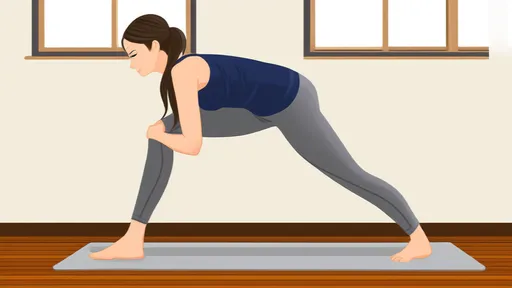
Focus on major muscle groups that are commonly tight, particularly for those with sedentary lifestyles. The hamstrings, located at the back of the thighs, are a primary culprit for lower back stiffness and an inability to bend forward. A safe way to stretch them is to sit on the floor with one leg extended and the other bent with the sole of the foot against the inner thigh. Hinge forward from the hips, not the lower back, towards the foot of the extended leg. The goal is not to touch your toes but to feel a stretch along the back of your leg. Similarly, the hip flexors, which become tight from prolonged sitting, are crucial for pelvic alignment. A simple lunge position can effectively target this area.
The chest and shoulders, often hunched forward from computer work and phone use, also demand attention. A doorway stretch is perfect for this. Stand in a doorway and place your forearms on the frame, elbows slightly below your shoulders, and gently step forward until you feel a stretch across your chest. The calves and quadriceps are other large muscle groups that benefit greatly from regular, gentle stretching. Consistency in practicing these fundamental stretches is infinitely more valuable than the intensity or duration of any single session.
Perhaps the most overlooked aspect of improving flexibility is the role of strength. Flexibility and strength are not opposing forces; they are complementary partners. A muscle that is both strong and flexible is a resilient muscle. For a stiff body, building strength provides stability and support, making it feel safer to explore a greater range of motion. Incorporating basic strength exercises into your routine is therefore not a distraction from your flexibility goals but a direct accelerator.
Bodyweight exercises like squats, glute bridges, and modified push-ups are excellent starting points. They build functional strength in the legs, hips, and core, which creates a stable foundation for deeper stretches. For instance, stronger core and hip muscles provide better support and control in a forward fold, allowing you to hinge more effectively from the hips without straining the lower back. This synergy between strength and flexibility is the secret to sustainable progress. It transforms stretching from a passive activity into an active process of building a more capable and integrated body.
Finally, the journey to flexibility is as much a mental practice as a physical one. Impatience is your greatest enemy. Progress will be measured in millimeters, not miles. Some days you will feel looser and more open, while on other days, you may feel tighter than when you started. This is completely normal and part of the process. The goal is to show up consistently, listen to your body's feedback with kindness, and celebrate the small victories—perhaps reaching an inch further towards your toes or feeling less stiffness when you get out of bed in the morning.
In conclusion, improving flexibility for the rigid-bodied individual is a holistic endeavor. It requires a dedicated warm-up, mindful and pain-free stretching, a partnership with strength training, and a heavy dose of patience. It is not about achieving dramatic poses but about cultivating a body that moves with greater ease, comfort, and freedom in everyday life. By respecting your body's limits and nurturing it with consistent practice, you will gradually unlock a potential for movement you never thought possible, transforming rigidity into resilience.

By /Aug 25, 2025
By /Aug 25, 2025
By /Aug 25, 2025

By /Aug 25, 2025

By /Aug 25, 2025

By /Aug 25, 2025

By /Aug 25, 2025

By /Aug 25, 2025

By /Aug 25, 2025

By /Aug 25, 2025

By /Aug 25, 2025
By /Aug 25, 2025

By /Aug 25, 2025

By /Aug 25, 2025

By /Aug 25, 2025

By /Aug 25, 2025

By /Aug 25, 2025

By /Aug 25, 2025

By /Aug 25, 2025

By /Aug 25, 2025
